
About the author
Rowan Thornwell
Fiction with heat, heart and sharp edges.
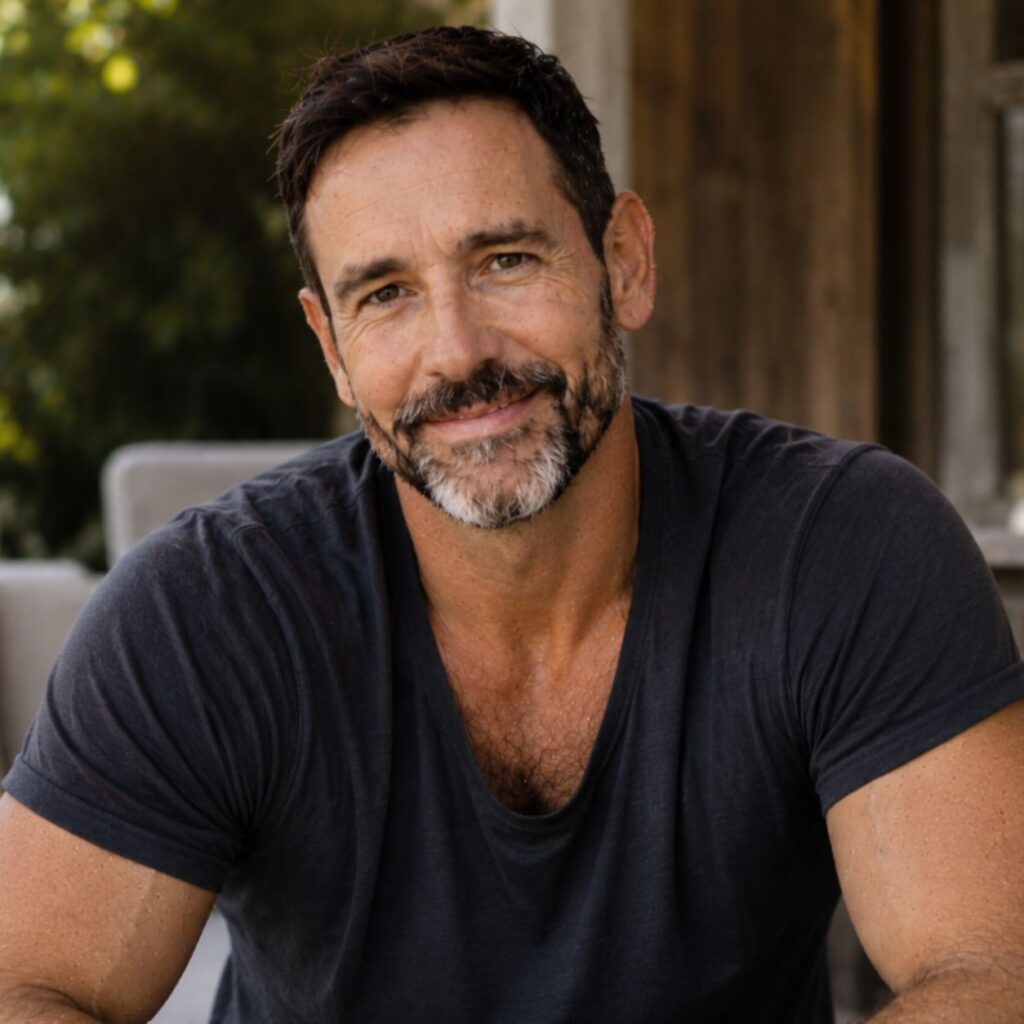
Meet Rowan
Desire refuses neat categories.
Rowan Thornwell writes about men, desire, power, shame, and the strange shapes love makes when nobody is forcing it to behave.
A Navy veteran, husband, father, and proudly bisexual author, Rowan writes from the charged space between vulnerability and surrender. His work is intimate, explicit, and interested in the precise things people are taught to hide.
What began with His, Theirs, Enough has grown into an expanding catalogue: queer romance, erotic fiction, horror, speculative stories, and worlds whose characters refuse to stay politely inside a single book.
In brief
The writer behind the work.
Rowan is home.
Rowan Thornwell began as a pseudonym—a little distance between a private life and the page. It became the name for the most honest, creative part of the man behind it.
Heat with consequence.
The books move across queer romance, lyrical erotica, horror and speculative fiction. Bodies matter, but so do trust, jealousy, tenderness, shame and what happens afterwards.
Complexity needs no apology.
Love can take more than one shape. Desire is specific, inconvenient and human. Honesty matters more than convention, and nobody must be perfect to be worthy of being wanted.
Where to begin
Start with the heart of it.
If you want to understand Rowan Thornwell, begin with His, Theirs, Enough: an emotionally intense story of Elias, Lina, Alaric and Nico, and the question beneath so much of Rowan’s work—what happens when desire refuses the shape it was given?
Tethered, Book One. Complicated love, surrender, jealousy and the fear of not being enough.
Meet the bookGo deeper
Two Years Tethered
The full conversation: building a body of work, writing desire without apology, and learning what remains when the platforms disappear.
Read the conversation
Question 01The last time you were interviewed, His, Theirs, Enough was your first published novel. Two years later, Rowan Thornwell has become something considerably bigger. What happened?
AI apparently have no capacity for doing anything sensibly.
I thought I was publishing a book.
That was the original ambition. Put His, Theirs, Enough into the world, see whether anybody cared, then perhaps quietly write another one. Instead, I opened a cupboard I’d been stuffing things into for most of my adult life and discovered there was a small publishing company hiding inside it.
Stories. Half-stories. Characters. Entire worlds. Notes written twenty years ago beside things I wrote last Tuesday. Novels that were almost finished without my realising they were novels. Some were romantic, some filthy, some strange, some funny, some genuinely quite dark.
Then readers arrived.
Not millions of them. I’m not going to start behaving like Beyoncé. But enough people found the work, wrote to me, bought books, joined mailing lists, followed various incarnations of me around the internet and asked what was coming next.
That changed something.
The past two years became this extraordinary mixture of creation, publishing, overreach, reinvention, occasional catastrophe and the slow realisation that I wasn’t trying to publish a book anymore.
I was building a body of work.
That feels much more interesting.
Question 02Looking back, was His, Theirs, Enough still the right book to begin with?
ACompletely.
At the time I said I didn’t know whether it was the right book, only that it was the truest. I understand that answer better now.
There are probably more commercial books I could have led with. Cleaner premises. Easier romances. Stories that announce themselves neatly in one sentence and behave appropriately once they get there.
Tethered was never going to do that.
Elias arrived carrying insecurity, desire, jealousy, surrender and this enormous need to understand whether being loved meant being enough. Around him grew Lina, Alaric and Nico, then this increasingly complicated idea of intimacy that refused to behave according to the usual mathematics.
That was the book I needed to write first because it established the central question underneath almost everything I write.
What happens when desire refuses to fit inside the shape we were given for it?
Two years later, I’m still writing around that question.
Question 03You once said Elias carried your soul. Does he still?
APoor bastard. Yes.
Although I think I’m kinder to him now.
When I first wrote Elias, I understood him primarily through ache. He wanted desperately to be enough while being terrified that somebody else’s desire automatically meant his own inadequacy.
That fear is incredibly human.
We’re taught to treat love like a competition. If somebody wants something you cannot provide, you’ve somehow failed. If their attention moves elsewhere for a moment, yours has been diminished. Desire becomes evidence entered against you.
Elias was built inside that fear.
What interests me now is watching him grow beyond it without turning him into somebody unrecognisable. Confidence doesn’t mean insecurity disappears. Love doesn’t magically cure jealousy. People remain complicated after the epiphany.
I want him to become larger without pretending the person he was never existed.
That is probably what I want for myself too.
Question 04The Tethered books have also become part of a much larger universe than you originally revealed. How much exists behind them?
AAn alarming amount.
Tethered existed before Rowan Thornwell did.
Parts of that world have been sitting in notebooks, documents, abandoned manuscripts and my head for years. Characters who appear briefly in one book have entire histories elsewhere. Someone standing at the edge of a scene may already have a novel waiting for them.
That has become one of my favourite things about writing.
I love the sense that the reader has entered somewhere already alive. The characters weren’t assembled five minutes before the opening chapter and they don’t evaporate after the final page. Everybody has come from somewhere.
There are prequels, continuations, side stories and books that intersect with the main series at odd angles.
For a long time, none of it was properly catalogued.
That was perhaps charming when it lived inside my head.
It became considerably less charming when I started publishing it.
Question 05You actually stopped the third Tethered novel rather than release it. Why?
ABecause it wasn’t right yet.
That decision hurt, but it was important.
There is a peculiar pressure once a series exists. Readers want the next book, you’ve announced things, schedules appear, covers exist, and suddenly the calendar starts behaving as though it outranks the story.
It doesn’t.
I had material for the third book. A lot of it. What I didn’t have was the book I wanted to put permanently beside the first two.
So I stopped.
I went back into the architecture of the series and started looking at continuity, character development, emotional consequences and where these people genuinely needed to go.
The old version of me might have thought stopping represented failure.
Now I think publishing something I knew could be better would have been the failure.
The books deserve patience.
So do the readers.
Question 06Rowan Thornwell is still a pseudonym. Has what the name means changed?
AYes.
Originally Rowan was a hiding place.
Not a dishonest one, but definitely a veil.
My wife and children know me. They’ve always had the unabridged edition, unfortunately for them. The rest of my life has required different versions of me in different rooms.
I’ve had careers where discretion mattered. I served in the Navy. I still have a life entirely separate from publishing. There are places where announcing what I write would certainly make the morning tea conversation more interesting, but not necessarily better.
Rowan gave me enough distance to write without constantly imagining who might be looking over my shoulder.
Something changed along the way.
He stopped feeling like somebody I invented and started feeling like the name I gave the creative part of myself.
I’m not performing when I’m Rowan.
If anything, I’m performing less.
Question 07Your Navy years were a strong influence on the first book. Do they still appear in your writing?
AConstantly, although not always literally.
Military life taught me a great deal about men.
Hierarchy. Masculinity. Ritual. Loyalty. Performance. Shame. Physical closeness. Emotional distance.
Put a group of young men into an intensely structured environment, teach them how they are expected to behave, give them uniforms and ranks, then place them together in spaces where privacy barely exists. You begin to notice the enormous difference between what men say they are and what they actually feel.
I was carrying my own questions about sexuality through that environment.
There was desire I didn’t always know how to name. Attraction that had nowhere respectable to go. Moments of extraordinary closeness between men who might never have described themselves as close.
That stayed with me.
The command structure stayed with me too. Power is fascinating when it is formalised. Being told where to stand, how to address somebody, when to move, when to wait. There is an obvious erotic vocabulary sitting inside that, although I’m fairly certain it wasn’t included in the recruitment brochure.
Those experiences still find their way into my characters.
Usually wearing different clothes.
Question 08You have written openly about being bisexual and about a relationship that doesn’t fit conventional expectations. Has writing changed how you understand that part of yourself?
AIt has made me considerably less interested in apologising for complexity.
I spent too much of my life thinking identity needed to be mathematically tidy.
Bisexuality is sometimes treated as an inconvenient transitional state. Pick a side, settle down, prove something.
I’m married to a woman I adore. I am also a man who experiences desire for men. Neither statement cancels the other.
Our relationship has had room for conversations and freedoms that other couples may not want, and that’s fine. I’ve never believed every relationship needs to operate according to the same rules.
What matters is honesty.
People hurt each other far more effectively with secrecy than they ever could with consensual complexity.
That idea sits at the centre of Tethered. Love cannot survive without truth, but truth occasionally asks more of us than comfort does.
Question 09Sex remains central to your work. Why are you so resistant to fading to black?
ABecause the black bit is often where the character is.
If two people have spent three hundred pages circling desire, fear, control, shame or vulnerability, then closing the door at the moment those things become physical can feel extraordinarily strange to me.
Bodies reveal character.
Who reaches first? Who hesitates? Who asks? Who assumes? Who gives? Who watches? Who needs reassurance afterwards?
That is story.
I’ve never been particularly interested in explicitness simply for the purpose of demonstrating that I’m brave enough to type anatomical nouns.
The physical scene earns its place when something changes because of it.
Sometimes that change is enormous. Occasionally it is the smallest shift in trust.
Either can matter.
And yes, sometimes sex is joyful, ridiculous, filthy and there because human beings enjoy having sex.
Literature is allowed to enjoy itself.
Question 10People have described your writing as lyrical erotica. Do you still like that description?
AMore than most labels.
Although anything containing the word lyrical immediately makes me worry I’m about to become unbearable at dinner.
What I respond to is the idea of physical rhythm inside prose.
Bodies have cadence. Conversation has cadence. Grief has it. Desire certainly does.
A sentence can rush when somebody loses control, then slow at exactly the moment a character becomes aware of what is happening to them. Paragraphs can tighten. Space can matter. Silence can carry more weight than another line of dialogue.
I don’t want prose merely to report that something happened.
I want the sentence to participate in the happening.
That applies far beyond sex.
A good line should alter the reader’s breathing without them noticing why.
Question 11Your earlier interviews spoke often about submission. Has your understanding of power changed since then?
AIt has become less theoretical.
Submission interests me because outsiders often mistake it for absence of power.
Chosen submission requires agency.
The person giving control must possess control before they can give it away. That distinction matters enormously.
What fascinates me now is everything surrounding the exchange. Trust. Negotiation. Anticipation. The psychology of wanting another person to decide something for you. The responsibility carried by the person accepting that authority.
Power becomes far more interesting once both people are understood as active participants.
That principle applies emotionally too.
Vulnerability looks passive until you realise how much courage it takes to place something fragile in somebody else’s hands.
Question 12Two years ago you were experimenting with several author identities. Rowan Thornwell, Marlo Sin, Plain Smut and others appeared at various points. Where did they go?
AInto the great cupboard of ideas I was convinced were brilliant at two in the morning.
I became obsessed for a while with categorisation.
This kind of story belongs under this name. Horror needs another name. Something purely erotic should sit somewhere else. Romance should behave differently again.
There was logic behind it. Readers like knowing what they are buying.
The problem was that I was slowly dividing myself into administrative departments.
Everything became branding.
Eventually I realised the common ingredient was more important than the differences.
Me.
I would rather Rowan contain multitudes than spend my life maintaining twelve fictional gentlemen and remembering which one owns which Instagram password.
So the centre of gravity moved back here.
Rowan is home.
Question 13Does that mean readers should expect more than one kind of book from you?
AAbsolutely.
I’m incapable of being interested in only one thing.
There will always be emotionally intense queer fiction. Romance matters deeply to me. So does eroticism.
But I also love horror, speculative fiction, science fiction, strange comedy, historical stories, masculine intimacy and books that become difficult to place neatly on a shelf.
Some ideas want three hundred pages.
Others need thirty thousand words and should be allowed to leave before they become house guests.
There are motel stories, sailors, monsters, rent boys, small towns, men in space, beautiful disasters and characters who have been waiting an indecent number of years for me to pay attention to them.
The catalogue will reflect that.
I’m much happier giving readers a clear description of what a particular book is than pretending every Rowan Thornwell book must be identical.
Question 14That catalogue has become a major focus for you. Why?
ABecause I finally understood what I was building.
For a while every release felt like an isolated event.
Write the book. Publish the book. Promote the book. Panic about the book. Repeat.
That is exhausting, particularly when you already possess years of material.
The better model for me is a library.
A reader discovers one book, then another door opens. Perhaps they move into the same series. Maybe they try something completely different. Eventually there is enough work that Rowan Thornwell becomes somewhere they visit rather than one title they vaguely remember seeing advertised.
That changes how I think about publishing.
A book does not have three weeks to succeed.
It can find somebody next year.
Or five years from now.
My job is to keep building the shelves.
Question 15You’ve described some of your work as coming from “the vault”. What is the Vault?
ABoth a real archive and a philosophy.
I have written for years without publishing most of it.
Some pieces are complete. Others are fragments with enough life in them to become something larger. Characters recur. Ideas mutate. A five-thousand-word story written years ago might suddenly reveal that it was chapter zero of a novel.
The Vault is where that material lives.
It also gives me somewhere to be less formal.
Not everything needs the ceremony of a major book release. Some stories can be stranger, shorter, more experimental or more immediate.
I like having a place where readers can wander deeper into the world.
Preferably carrying a torch.
Question 16You built sizeable audiences online very quickly, then much of that infrastructure disappeared. What happened to your relationship with platforms?
AI learned the difference between building an audience and renting one.
That lesson was not subtle.
At various points I built publications quickly, accumulated thousands of subscribers and followers, experimented with different formats, moved readers between platforms and became far too interested in numbers going upwards.
Then things changed.
Platforms made decisions. I made mistakes. Projects disappeared. Communities fractured. Something I had spent enormous energy constructing could effectively cease to exist overnight.
For a while I took that personally.
Eventually I realised it was useful.
The books survived.
When the feeds vanished, the books were still sitting there.
That clarified everything.
I don’t want Rowan Thornwell to be a social-media project that occasionally produces novels.
I want Rowan Thornwell to be an author whose books sometimes happen to appear on social media.
That distinction has probably saved the whole thing.
Question 17There was a period when Rowan almost disappeared altogether. How close did you come to stopping?
AClose enough to take the possibility seriously.
I had exhausted myself.
Part of that came from trying to create too much infrastructure around the writing. Publications, newsletters, serials, websites, identities, memberships, platforms, schedules.
Suddenly I was managing Rowan more than I was being Rowan.
When some of those structures collapsed, I had to decide whether I actually wanted to rebuild them.
For a while the answer was no.
Then I looked at the books.
That was the answer.
I didn’t miss maintaining a content machine.
I missed writing Elias.
I missed inventing people.
I missed sentences.
Once I understood that, the path back became fairly obvious.
Strip away everything that isn’t essential.
Keep the books.
Question 18And yet you are building a new website. Isn’t that infrastructure again?
AYes, but this time the website knows its place.
It is not the work.
It is the front door.
I want somebody to arrive here and immediately understand what I write, which book they might enjoy, where to begin, what is coming next and how to find it.
No labyrinth.
No expectation that readers need to join a digital commune before they’re allowed to buy a novel.
Browse. Read. Stay if you want.
That is enough.
Question 19Why remain committed to self-publishing after everything you’ve learned?
AControl.
Not because traditional publishing is evil. It plainly isn’t.
I simply know myself.
I care about covers. Titles. Release order. Pricing. Series architecture. The wording on a page most people will never notice. I will change something because a comma is irritating me at midnight.
That temperament is probably intolerable inside a system requiring several committees.
Self-publishing lets me build slowly where I want to build slowly and move quickly when something is ready.
It also allows the catalogue to be unusual.
Nobody has to explain to a sales department why one Rowan Thornwell book is a sprawling emotional romance and the next involves something deeply questionable happening in a motel.
I merely have to explain it to you.
Question 20Is commercial success important to you?
AOf course.
Anyone claiming otherwise while putting books on sale is being unnecessarily theatrical.
I want these books to sell.
I want Rowan Thornwell to become recognisable. I want readers waiting for releases. I want a large catalogue that continues finding people long after launch week.
I’d love the writing eventually to occupy a much larger part of my life.
But the definition of success has changed.
A spike is lovely.
Longevity is better.
I’m increasingly interested in what happens if I do this properly for ten years rather than what happens if one post explodes on a Tuesday.
That is a much calmer ambition.
Ironically, it may also be the larger one.
Question 21You seem to have become more ambitious rather than less.
ACatastrophically.
The difference is that the ambition has somewhere useful to go now.
At one stage I wanted everything immediately. More publications. More readers. More names. More stories. More channels. More everything.
The result was motion without enough direction.
Now I want depth.
I want twenty, thirty, forty books sitting behind this name eventually.
I want characters who cross between them. Series readers can disappear into. Standalones that surprise people. Older books revised when they need revising rather than abandoned because they are no longer new.
That still represents an absurd amount of work.
It just feels like meaningful work.
Question 22With such a large backlog of ideas, how do you decide what actually becomes a book?
AThe character usually refuses to leave.
Premises are cheap.
I can think of ten premises before lunch and nine of them should probably be prevented from reproducing.
A book begins when somebody inside the premise develops gravity.
They start having opinions I didn’t give them. History appears. Contradictions form. I find myself wondering what they would do in situations entirely unrelated to the original story.
That is usually the moment I’m in trouble.
Elias did that.
So have many of the people waiting behind him.
Characters are terribly inconsiderate about publishing schedules.
Question 23Are there subjects you’re more willing to write about now than you were when you began?
AShame, particularly male shame.
I think I used to write around it.
Now I find it difficult to look away.
Men are given some extraordinarily narrow instructions about which parts of themselves are permitted to exist. Desire becomes performance. Tenderness gets disguised. Fear becomes anger. Loneliness gets translated into silence.
Sexuality makes those rules even more complicated.
I’m interested in the moments where the performance fails.
The straight man who wants something he cannot reconcile with the story he has told about himself.
The dominant man terrified by tenderness.
The man who can surrender physically but cannot say that he needs somebody.
The bisexual man who thinks loving one person requires deleting part of himself.
Those contradictions feel endlessly rich to me.
Not because I want to lecture anybody.
I just think people become fascinating where certainty cracks.
Question 24Has becoming older changed the kind of desire you write?
ACompletely.
Thank God.
Desire at twenty is often about being wanted.
Later, I think it becomes much more interesting to ask what being known would cost.
Bodies change. Confidence changes. Shame changes shape. People accumulate history.
You learn that beauty is considerably stranger than you were taught.
You also become less impressed by perfection.
Give me somebody with a scar, an insecurity, a ridiculous laugh, a body part they hate, a secret they are convinced makes them undesirable.
That person is already more interesting than the flawless stranger leaning against the metaphorical doorframe.
Attraction becomes specific.
Specificity is where erotic writing comes alive.
Question 25Your earliest writing about sex often talked about making overlooked desires feel worthy. Is that still important?
AVery.
Erotic culture can be bizarrely conservative about desire while pretending to be transgressive.
The acceptable bodies merely change costume.
I’m interested in what falls outside the approved fantasy.
Ageing bodies. Small bodies. Large bodies. Unfashionable bodies. Awkwardness. Feet. Hair. Softness. Scars. Particular obsessions that somebody has spent twenty years assuming make them peculiar.
There is tremendous intimacy in specificity.
Being told you are generically attractive is pleasant.
Being wanted for the precise thing you thought you needed to hide can rearrange a person.
That moment fascinates me.
Question 26Do you still believe erotica can be “filthy and holy”?
AMore than ever.
Those things were never opposites.
Sacredness does not require cleanliness.
Some of the most profound human experiences are messy, bodily and undignified.
Birth certainly is.
Grief can be.
Sex often is.
The holiness, if we insist on using that word, comes from attention.
Two people fully present with each other.
Someone being trusted with a vulnerability.
Pleasure given carefully.
A body treated as something worthy of fascination rather than judgement.
There can be tremendous reverence inside something extremely filthy.
I enjoy that contradiction far too much to abandon it.
Question 27What about love? After writing so much about unconventional relationships, what do you actually believe makes one work?
AFriendship.
That answer is far less erotic than people expect from me.
My wife is my best friend.
Everything else has somewhere to return because of that.
Relationships change. Bodies change. Desire moves around. People become busy, exhausted, ill, ambitious, frightened and occasionally impossible.
The friendship is what remembers why you like each other.
I don’t believe every couple needs openness, monogamy, marriage or any particular configuration.
I do believe they need truth.
And preferably somebody who can still make you laugh when everything has gone spectacularly wrong.
That helps.
Question 28Your family has lived through Rowan Thornwell becoming increasingly real. How do they feel about all this?
AAmused, mostly.
They have the advantage of knowing the man behind the dramatic serif typography.
There is something wonderfully deflating about writing a paragraph you think contains the accumulated erotic wisdom of civilisation, then being asked whether you remembered to put something in the dishwasher.
Family restores proportion.
My wife has been enormously supportive. She understands that writing isn’t a hobby I happened to pick up two years ago. The stories were already here.
Publishing simply made them visible.
I’m incredibly lucky in that respect.
Question 29You have a demanding life outside writing. Where does the work fit?
AInto every available crack.
I wish I could tell you I rise at five, drink something containing chia seeds and write two thousand disciplined words while the sun appears over the horizon.
Absolutely not.
Life is noisy.
Work exists. Family exists. Health occasionally stages a coup. Responsibilities do not politely disappear because a fictional man is having an emotional breakthrough.
So I write where I can.
Sometimes the work comes in long, luxurious sessions.
More often it arrives in pieces.
The important thing is that I keep returning.
A novel is extraordinarily forgiving about how glamorous the process was once the pages exist.
Question 30Has the past year, particularly the interruptions and setbacks, altered your relationship with time?
AVery much.
Nothing clarifies ambition like suddenly being unable to do the things you assumed would always be available to you.
I’ve had periods recently where life forced everything to slow down.
That was frustrating, but useful.
There are only so many books I will get to write.
That sounds grim, but I find it motivating.
Why spend those years trying to manufacture a version of myself I think an algorithm might prefer?
I would rather make the strange books.
Finish the series.
Rescue the old manuscripts.
Write the thing that might fail magnificently instead of the thing designed to succeed forgettably.
Time has made me greedier for the work that actually matters.
Question 31What has surprised you most about readers?
AWhat they remember.
I’ll spend weeks worrying about some enormous narrative decision and somebody will write to me about a four-line moment I barely remember writing.
A gesture.
A sentence.
Something a character does after sex.
An insecurity I thought was too specific for anybody else to recognise.
That is wonderful.
Books become completely different objects once another person has lived inside them.
The reader brings history I don’t know.
Suddenly a scene means something I never deliberately placed there.
You realise publication is the point where ownership becomes slightly mysterious.
The book remains mine.
The experience of it doesn’t.
Question 32What do you want a new reader arriving at RowanThornwell.com to understand immediately?
AThat they are allowed to choose their own door.
You do not need to begin with the oldest book.
You do not need to read everything.
Some readers will want Tethered because they want emotional intensity, complicated love and a series they can disappear into.
Someone else wants a motel, questionable decisions and significantly less emotional preparation.
Another reader might want science fiction, darkness, romance, history or something I haven’t published yet.
The site should help them find that door.
After that, I’ll meet them inside.
Question 33So where should somebody actually start?
AIf you want to understand the heart of Rowan Thornwell, start with His, Theirs, Enough.
It remains the closest thing to a manifesto I have accidentally written.
If the premise makes you nervous, excellent.
If Elias frustrates you, give him time.
If Nico immediately causes problems for you, that is entirely his function.
Then follow wherever your curiosity takes you.
There is no examination afterwards.
Question 34What is the difference between Rowan Thornwell now and the writer who published that first novel?
AHe trusts the work more.
The first version of Rowan needed evidence constantly.
Subscribers. Reviews. Sales. Likes. Growth. Some external indication that I had been granted permission to keep going.
I still enjoy all of those things.
Please continue buying the books.
But they don’t determine whether I write the next one.
I know now that the stories exist independently of applause.
That gives me a freedom I didn’t have at the beginning.
Success would be wonderful.
Permission is no longer required.
Question 35After everything that happened, do you regret the chaos of those first two years?
ANot really.
I would make some different decisions.
Several.
There are entire afternoons I would like returned.
But the chaos taught me what was durable.
A platform wasn’t durable.
A follower count wasn’t durable.
Whatever brilliant scheme I had invented at two in the morning usually wasn’t durable.
The characters were.
The books were.
The desire to make another one was.
That is a useful thing to learn early.
Question 36What are you building now?
AA catalogue.
A world.
Possibly several worlds.
Most importantly, a body of work substantial enough that one day somebody can discover Rowan Thornwell accidentally and wonder where the hell all these books came from.
I love that idea.
There will be continuations of stories readers already know. Older work will be revisited where it deserves another look. New series are waiting. Standalones are becoming increasingly impatient.
The pace will be consistent, but I’m no longer interested in feeding a machine merely because it appears hungry.
Every book should earn its place.
Eventually I want the Rowan Thornwell shelf to feel enormous.
Not because quantity itself impresses me.
Because I have a lot left to say.
Question 37What do you hope the next two years look like?
ALess whirlwind.
More books.
I would like the chaos to move onto the page where it belongs.
I want readers finding the catalogue, finishing one story and immediately reaching for another.
I want Tethered to continue becoming what I always knew it could be.
There are books I’ve carried for years that I’m finally ready to finish.
There are also ideas arriving now that are better because I’m a better writer than I was when this began.
That is perhaps the most exciting part.
The Vault is no longer merely a collection of old material.
New things are going into it.
Question 38Has your definition of a writer changed?
AYes.
I used to think becoming a writer involved publication.
Then perhaps sales.
Recognition seemed useful.
Eventually some mythical threshold would be crossed and I’d feel officially authorised.
None of that happened.
I just kept writing.
That turned out to be the qualification.
Everything else is publishing.
Question 39Finally, two years ago you were asked what you would whisper to somebody before they opened your first novel. Your answer was essentially: get ready to ache, to be seen, to want something you didn’t know you were allowed to want. What would you say now, before somebody enters the entire Rowan Thornwell catalogue?
ACome curious.
You don’t have to want everything you find here.
I don’t.
Some stories will make you ache. Others might make you uncomfortable. A few are designed primarily to make you extremely happy you closed the bedroom door.
There will be men who love badly before they learn to love well.
People will surrender things they thought defined them.
Bodies will behave like bodies.
Desire will remain inconvenient.
Love will refuse to behave itself.
Nobody is required to be perfect before they are worthy of being wanted.
That may be the only idea connecting everything I write.
Come in.
Choose a door.
Let’s see what happens.
Come curious